


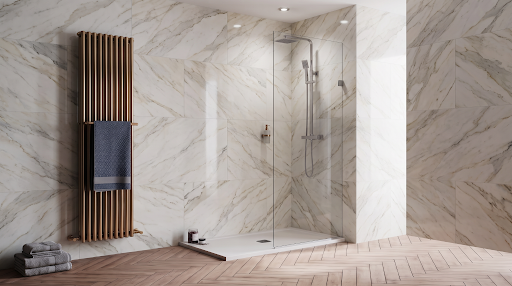
A Frameless Fixed Shower Screen is essentially a stationary sheet of safety glass used to separate the showering area from the rest of the bathroom without relying on a swinging or sliding door. This frameless fixed shower screen for bathroom design is common in walk-in showers because it creates a more open visual space while providing a barrier against water spray. Current U.S. shower products commonly describe these systems as fixed shower panels, fixed shower screens, walk-in shower panels, or single fixed glass panels.
Unlike a framed enclosure, a fixed panel has no perimeter frame surrounding the glass. Depending on the design, it may be secured with wall-mounted clamps, channels, brackets, or a stabilizing bar. The simplicity is appealing, but the success of the installation depends heavily on shower layout, panel dimensions, glass specification, wall conditions, and the direction of water spray.
What Is a Fixed Shower Screen for Bathroom?
A fixed shower screen is a stationary glass panel that remains in one position after installation. It does not swing, slide, or fold. The panel creates a partial physical separation between the wet and dry areas of a bathroom while leaving an open entry.
This is different from a conventional shower door. A shower door is designed to move and close an opening, whereas a fixed panel primarily functions as a splash barrier. Some bathrooms combine a fixed panel with a hinged door when greater water containment is necessary.
The distinction matters because a fixed panel cannot be expected to contain water in exactly the same way as a fully enclosed shower. The showerhead position, panel width, entry opening, floor slope, curb or threshold, and shower dimensions all affect how effectively water remains inside the wet area.
Why Fixed Glass Panels Are Popular in Walk-In Showers
The biggest design advantage is openness. A large clear glass panel allows light to travel through the bathroom instead of visually dividing the shower into a separate compartment. This can be particularly useful in smaller bathrooms where a heavy frame or opaque enclosure could make the room feel more enclosed.
A fixed panel also eliminates many moving components. There are no rollers to adjust, no sliding track to clean, and no door hinges that need to support a moving glass leaf. That does not make the installation maintenance-free, but it can simplify the system.
U.S. retailers and manufacturers currently offer fixed frameless panels in numerous widths and heights, including products around 72 and 78 inches tall, while custom glass fabricators can produce panels for individual openings.
Choosing the Right Glass for a Fixed Shower Panel
Glass selection should begin with safety rather than appearance. Shower panels should use appropriately specified tempered safety glass manufactured for architectural applications. Tempered glass is heat-treated so that, if it breaks, it generally fractures into smaller particles rather than large sharp shards characteristic of ordinary annealed glass.
Common fixed shower panels in the U.S. market use 3/8-inch tempered glass, although thinner and thicker configurations exist depending on the product, dimensions, hardware, and installation requirements. Current products from several U.S. suppliers list 3/8-inch tempered glass as a standard specification for fixed shower panels.
Glass thickness should not be selected simply because thicker glass sounds stronger. The panel’s dimensions, mounting method, support configuration, hardware capacity, and applicable safety requirements all need to be considered.
Clear, Low-Iron, Frosted and Patterned Glass
Clear glass is the most visually open option and is often selected when the goal is to make a bathroom appear larger.
Low-iron glass reduces the green tint that can be visible along the edge of standard clear glass, producing a cleaner appearance, particularly when the glass is viewed against white tile or other light-colored surfaces.
Frosted, textured, fluted, or patterned glass can provide greater visual privacy. For example, fluted fixed panels are available in the U.S. market and are specifically designed to diffuse light while obscuring direct visibility.
The choice is therefore not simply aesthetic. Glass transparency affects privacy, light transmission, and the visual relationship between the shower and the rest of the bathroom.
How Wide Should a Fixed Shower Panel Be?
There is no universal panel width that works for every bathroom. The correct size depends on the shower’s total opening and, more importantly, how water moves inside the space.
A narrow panel may leave a large opening that allows water to escape. A very wide panel can improve splash protection but may reduce the openness that makes a walk-in shower attractive.
Commercially available panels illustrate the range. U.S. products can be found in widths from relatively narrow panels to substantially wider single panels, while custom fabrication allows dimensions to be matched to a particular shower opening.
Before deciding on the width, consider the position of the showerhead. A showerhead aimed directly toward the opening creates a very different water-management problem from one positioned against the back wall and aimed toward the opposite side.
Measuring for a Fixed Shower Screen
Accurate measurement is one of the most important parts of the process. Do not assume that a tiled shower wall is perfectly straight or that the opening has identical dimensions from top to bottom. Measure the intended panel location at multiple points and check whether the walls are plumb.
The finished floor is equally important. A shower floor should direct water toward the drain rather than toward the bathroom entrance. If the floor slopes incorrectly, even a properly sized glass panel may not prevent water from escaping.
Before ordering glass, verify the final tile thickness, wall finish, curb or threshold dimensions, and mounting location. Hardware placement can also influence the final glass size, so measurements should account for the actual installation method rather than simply measuring the visible opening.
Hardware and Stabilization
A frameless panel does not mean the glass is unsupported. Fixed panels need an appropriate attachment system.
Depending on the installation, hardware may include glass clamps, U-channels, wall brackets, or stabilizer bars. A stabilizing bar can provide additional rigidity for a tall or wide panel and is commonly used when the panel is not supported along another edge. Current fixed-panel systems in the U.S. market use combinations of clamps and stabilizing hardware for this purpose.
The mounting surface matters just as much as the hardware. Anchors need to be installed into suitable structural material rather than relying solely on tile or a weak surface layer.
Fixed Panels and Water Containment
One of the most common misconceptions about a doorless shower is that the glass itself determines whether water stays inside. It doesn’t. Water containment is a system-level issue. The showerhead location, spray pattern, panel size, shower entry, floor slope, drain location, curb configuration, and bathroom ventilation all contribute to performance.
A fixed panel can work extremely well when the shower is designed around an open configuration. But simply replacing a shower door with a narrow piece of glass does not automatically produce a functional walk-in shower.
For bathrooms with aggressive spray patterns or limited space between the showerhead and entry, a larger panel or a door-equipped enclosure may provide better containment.
Is a Fixed Shower Panel Good for a Small Bathroom?
A fixed panel can be particularly useful in a compact bathroom because it removes the swing clearance required by a hinged door.
That can free up usable floor space immediately outside the shower. A transparent panel also maintains a continuous visual line across the room, which can make a small bathroom feel less segmented.
However, there is a trade-off. A small bathroom has less physical distance available for containing spray. If the shower is extremely compact, an open walk-in configuration may allow water to reach areas outside the intended wet zone.
The design should therefore be based on the shower’s actual geometry rather than the assumption that “frameless” automatically means better for a small space.
Cleaning and Maintaining Shower Glass
Glass itself is relatively easy to maintain, but shower glass is constantly exposed to water minerals, soap residue, body oils, and cleaning products.
A simple routine can make a substantial difference. After showering, removing excess water with a squeegee reduces the amount of mineral residue left behind as water evaporates. Periodic cleaning with a cleaner appropriate for the specific glass and surrounding surfaces helps prevent buildup.
Some manufacturers offer factory-applied protective coatings intended to make water and soap residue easier to remove. These coatings do not eliminate cleaning; they are designed to change how contaminants interact with the glass. Products currently marketed in the U.S. include coated fixed shower panels with water- and residue-repelling treatments.
Avoid assuming that every household cleaner is appropriate for every glass coating, metal finish, tile surface, or stone countertop. Manufacturer instructions should take precedence.
Fixed Shower Screen vs. Shower Door
The choice ultimately comes down to how the bathroom needs to function. A fixed panel provides an open entry and eliminates moving door hardware. A hinged shower door provides a closable opening and generally offers greater splash containment. A sliding door can be useful where swing clearance is limited but requires additional hardware and space for the sliding mechanism.
For a genuinely open walk-in shower, a stationary panel may be appropriate. For a shower where controlling every drop of water is the priority, a door-equipped enclosure may make more sense.
Neither configuration is universally superior. The bathroom layout determines which approach is practical.
Installation: DIY or Professional?
Installing a large sheet of tempered glass is not comparable to hanging a lightweight bathroom accessory. Large panels are heavy, difficult to maneuver, and vulnerable to damage if their edges are struck against hard surfaces.
The installation also requires accurate positioning, secure anchoring, appropriate clearances, and proper sealing where necessary.
Experienced installers understand how to handle the glass safely and how to account for wall conditions, tile thickness, hardware placement, and floor slope. DIY installation may be possible for appropriately designed systems, but the difficulty increases significantly with larger or heavier panels.
The most important point is not whether installation is labeled “easy.” It is whether the person performing it can safely handle the glass and install the supporting hardware correctly.
Final Considerations Before Choosing a Fixed Shower Panel
A successful walk-in shower starts with the layout rather than the glass. Determine where the water will spray, where the user will enter, how much splash protection is required, and where the drain and finished floor will direct water.
Then select the appropriate glass type, thickness, dimensions, hardware, and stabilization method.
A well-designed frameless fixed shower screen for bathroom can provide a clean, open appearance while creating a practical separation between the shower and the rest of the room. The minimalist appearance is only one part of the equation, though. Proper measurement, tempered safety glass, structural support, water management, and installation quality ultimately determine whether the finished shower performs as intended.
For homeowners comparing shower configurations, the smartest approach is to evaluate the entire shower system rather than choosing glass based solely on appearance or thickness. A beautiful panel installed in the wrong location can still produce a frustrating bathroom.
Good interior design is often about small, comfortable details, much like a warm sausage roll on a cold day. If you are in the UK and want to know what a casual bakery stop typically costs, check greggsmenuprice.uk for current price ranges.

