


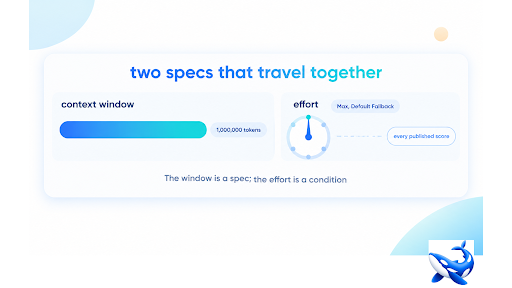
The Claude Opus 5.5 context window is 1,000,000 tokens — the same figure as GPT-6.1 Sol and GPT-6 Astra in this series’ comparison set, and twice xAI’s 500,000 on Grok 4.7. Anthropic’s Claude Opus 5.5 is carried here at list rate with no markup, so the field on our page and the field on the vendor’s agree. Read 2026-10-07.
The window is only half of what this article has to say, because there is a second setting attached to this model that decides how much of any published number you can use, and it is the one that gets left off.
What a million tokens actually buys
A context window is a ceiling, and like most ceilings it is interesting only in relation to what you actually put under it.
For most pipelines the number is never approached. A chat turn, a code completion, a summarised document — these live in the low thousands of tokens and would fit in any context window on the market. For that traffic, 1,000,000 is a reassurance rather than a feature, and a smaller window would cost nothing.
The workloads that need it are specific and they are the reason the number is quoted at all:
- Whole-repository reading. Pointing an agent at a codebase rather than at a handful of retrieved files, so it can see the call graph rather than a slice of it.
- Long-horizon agentic runs. A task that accumulates tool output, diffs and prior reasoning across hours, where the transcript is the state.
- Multi-document synthesis. Comparing a contract against a policy, or a filing against three years of filings, without a retrieval step deciding in advance what matters.
Two things follow that a spec sheet does not say. The first is that a large window is a *capacity* claim, not an accuracy claim — nothing about fitting a million tokens in says the model uses the middle of them well, and long-context retrieval is a measured thing rather than an implied one. The second is that cost scales with what you send, so a window large enough to hold a repository is also large enough to make a careless prompt expensive.
| model | context window |
| Claude Opus 5.5 | 1,000,000 |
| GPT-6.1 Sol | 1,000,000 |
| GPT-6 Astra | 1,000,000 |
| Grok 4.7 | 500,000 |
The setting that travels with every score
Now the part that decides how much of those other numbers you can compare.
Independent evaluations are run at a configuration, and for Anthropic’s models that configuration has a name. Claude Opus 5.5 is measured at Max effort, recorded as `Max, Default Fallback`. The OpenAI models in this series are also measured at Max; Grok 4.7 is measured at Xhigh, one rung lower. Read 2026-10-07.
Effort is the knob that decides how much internal reasoning the model does before it answers. Turn it up and the model thinks longer, which normally costs more tokens and more wall-clock time and tends to raise measured quality. Turn it down and the reverse. So an effort setting is not a footnote to a score — it is half of what the score means.
| model | effort setting | max level |
| Claude Opus 5.5 | Max, Default Fallback | 60 |
| GPT-6.1 Sol | Max | 60 |
| GPT-6 Astra | Max | 60 |
| Grok 4.7 | Xhigh | 50 |
There is a reason “Default Fallback” appears in that string, and it is worth separating the two halves. Max is where the model was measured. Default Fallback is what a request gets when it does not ask for anything — the harness falls back to the default rather than forcing the top rung. Those are different facts about different things, and a table that records only “Max” is recording the measurement condition while dropping the one that describes what an ordinary call does.
The consequence is concrete. If you send a request without specifying an effort level, you are not necessarily running the configuration that produced the published score — you are running whatever the default resolves to. A benchmark you are trying to reproduce may not be reproducible by default. That is not a defect in the benchmark; it is a property of a model line where effort is a first-class parameter, and it applies to every model in this table.
What the window does to the score
The two settings interact, and the interaction is where a long-context plan can go wrong.
A larger window makes it possible to send more, and more input tokens at Max effort with a long reasoning trace is the most expensive shape a request can take on this model — a $4 input rate applied to a repository-sized prefix, plus a reasoning trace billed at $20 output. The window is what lets you do it; nothing about the window makes it economical.
The honest reading of the pair is therefore:
- The window is a capability. It removes a hard failure mode — the request that could not be made at all — and it is the same on our page and the vendor’s.
- The effort setting is a condition. Every quality number quoted for this model was taken at Max, and any comparison against a model measured at a different rung is a comparison of configurations rather than of models.
- Neither is a cost figure. For that, the independent harness prices a finished task on this model at $5.98, read 2026-10-07 — the dearest of the ten models in that pull. Long context is the most likely reason your own number would land above it.
Four checks before you size a Claude Opus 5.5 prompt
Four checks, in the order they change the answer.
Decide whether you need the window at all. A million tokens is a requirement for whole-repository and multi-document work and a non-feature for everything else. If your traffic never exceeds a few thousand tokens, this spec is not a reason to choose the model.
Measure retrieval inside the window, not just the fit. Fitting a document in is not the same as using it. Test the model on a fact buried in the middle of a long prefix before you build a pipeline that assumes it will find it.
Send the effort level explicitly. The published score was taken at Max, recorded as `Max, Default Fallback`. If your request asks for nothing, you are not necessarily running what was measured — and if you are comparing two models, put both at the same rung.
Price the prefix before you use it. Long context is where the input line stops being a rounding error. Count the tokens a realistic request would carry and price them at $4 per million, with the reasoning trace at $20, before you make the window part of the design.
The takeaway
Claude Opus 5.5 carries a 1,000,000-token context window — twice Grok 4.7’s 500,000 and level with the two OpenAI models in this comparison set — read 2026-10-07 and the same on our page as on the vendor’s. It is a real capability for whole-repository, long-horizon and multi-document work, and a spec that most traffic will never touch.
The number that travels with it is the one to remember: every published quality figure for this model was taken at Max effort, recorded as `Max, Default Fallback`, against a max level of 60 and against Grok 4.7’s Xhigh at 50. A cross-model table without that label is a table of configurations, and a request that specifies no effort is not necessarily running the configuration that was measured.
Size the prompt, set the effort, then price the task.
OrcaRouter carries Claude Opus 5.5 at list rate on the same key as the rest of the Anthropic line, so testing a long-context workload at a chosen effort level is a model-string change rather than a second integration.
Sourcing note: the 1,000,000-token context window, the four-model context comparison and the effort settings of `Max, Default Fallback` for Claude Opus 5.5, Max for GPT-6.1 Sol and GPT-6 Astra, and Xhigh for Grok 4.7 with the max levels of 60 and 50, are from Artificial Analysis’ live pages, read 2026-10-07. The $4 input and $20 output rates and the one-million-token context figure are Anthropic’s own published claims, as is the existence of the reasoning-effort parameter with a default level. The per-task cost of $5.98 is from Artificial Analysis’ live pages, read the same day. The reading that a large window is a capacity claim rather than an accuracy claim, that Max and Default Fallback describe different things and only one of them is what an ordinary request gets, and that the window and the effort setting interact in the cost of a long-context workload, are this article’s own analysis. All checked 2026-10-07; re-check before 2026-11-01.

